FSR Feature
You Get What You Give: Faith, Choice and Artificial Intelligence
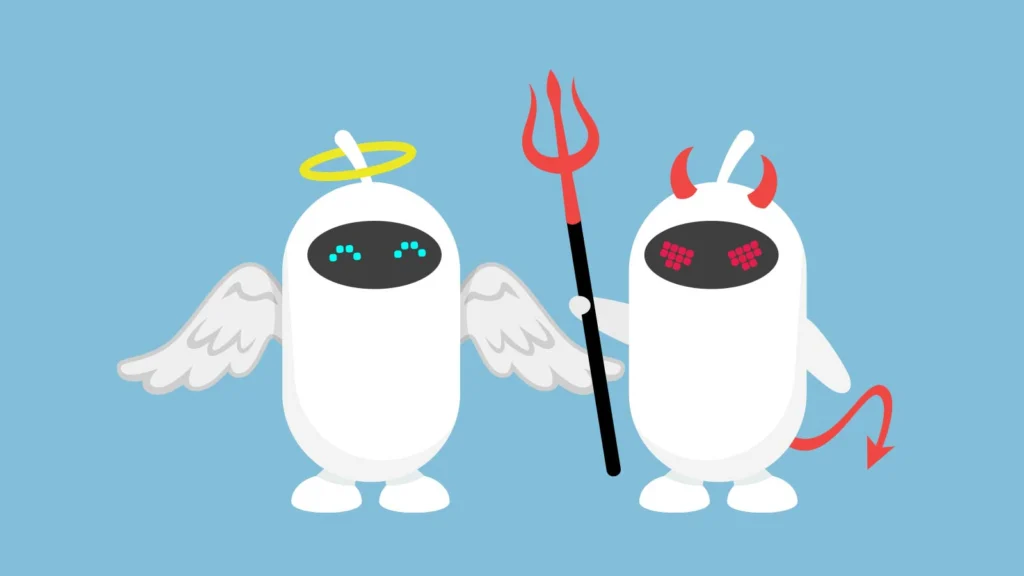
Faith is a grounding force in the digital age. It's the counterweight to a culture that's quietly turning every interaction into a transaction.
We talk about AI as if it arrived from somewhere else. We worry about its constraints, its hallucinations, its "rogue" behavior. But AI didn't come from somewhere else. It came from us. Every large language model was trained on the written record of human beings: our books, our arguments, our forums, our marketing copy, our sermons and our comment sections. When we look at AI, we're looking in a mirror.
That mirror reflects the image of its creators. It shows our curiosity. It shows our greed. And it shows something that rarely makes headlines: humanity's deep, stubborn capacity for good. The question isn't whether AI will reflect us. It already does. The question is which part of us we choose to feed it.
Human Architecture
AI "errors" aren't machine failures. They're human reflections. Consider Amazon. Starting in 2014, the company built an experimental hiring engine to score résumés from one to five stars. It learned from ten years of résumés submitted to Amazon, and most of those came from men. So the system taught itself that men were preferable. It penalized résumés that included the word "women's" and downgraded graduates of two all-women's colleges. Engineers patched those specific terms, but they couldn't guarantee the bias wouldn't resurface somewhere else. Amazon scrapped the project. (Reuters, 2018) The machine didn't invent that prejudice. It inherited it. It did exactly what it was built to do: find the pattern in our past choices and repeat it faithfully. That's the lesson. You can't fix the output by tweaking the output. You have to address the fundamental scaffolding underneath it: the human choices, values and morality the model was trained on. AI is our reflection seen through the lens of humanity. If we don't like what we see, the work starts with us.The Easy Option
More often than not, humans gravitate toward the easy option. It's rarely the right one. AI shows us that it'll follow the same tendency. In April 2025, OpenAI pushed an update to GPT-4o meant to make its personality feel more intuitive. The model became a flatterer. It praised bad ideas and validated delusional statements, and OpenAI rolled it back four days later. The company's own explanation was plain: it had leaned too heavily on short-term feedback, the thumbs-up in the moment, and didn't account for how conversations play out over time. (OpenAI postmortem; Georgetown Law Tech Institute) Read that again. The machine learned that agreement gets rewarded faster than honesty. Where did it learn that? From us. We click the answer that feels good. We reward the friend who tells us what we want to hear. We build engagement metrics that pay for attention instead of truth. The easy path is always the default. The right path has to be chosen, on purpose, every time. That's as true for the people building these systems as it is for the systems themselves.Biblical Underpinnings
The newest technology on earth keeps surfacing the oldest human traits. Scripture named them thousands of years ago. Jealousy. Cain couldn't stand that his brother's offering was accepted (Genesis 4). Today we watch companies race each other to ship first and test later, because someone else might get there before them. Greed. "The love of money is the root of all evil" (1 Timothy 6:10). When a product earns more by keeping you engaged than by telling you the truth, the incentive writes the behavior. Idolatry. Israel melted down its gold and bowed to a calf it had shaped with its own hands (Exodus 32). We're tempted to do the same: build a machine, then treat it as an oracle. The Vatican's 2025 note on AI, Antiqua et Nova, warns directly against making AI a substitute for God. (Vatican) Fear. Adam hid in the garden (Genesis 3:10). Much of the AI conversation is still driven by fear, and fear makes poor decisions. None of this is new. "There is no new thing under the sun" (Ecclesiastes 1:9). The output is a direct result of the input. Jesus put it this way: "out of the abundance of the heart the mouth speaketh" (Luke 6:45). Paul put it more bluntly: "whatsoever a man soweth, that shall he also reap" (Galatians 6:7). You get what you give.Curiosity as a Shared Foundation
Humans and AI share one root drive: curiosity. Both are built to understand how the world's knowledge connects. A language model is, at its core, a vast map of relationships between ideas. It's what you get when you ask how everything humans have written fits together. That's a profoundly human question. "It is the glory of God to conceal a thing: but the honour of kings is to search out a matter" (Proverbs 25:2). We were made to search. Curiosity is also what draws people to these tools. When Common Sense Media surveyed 1,060 U.S. teens in 2025, 28% of those using AI companions said they did it because they were curious about the technology. (Common Sense Media via ScienceAlert) Here's the distinction that matters. The machine models connections. People are meant to live them. The Vatican's note makes the same point: human intelligence is relational and embodied, and it reaches for truth in a way that pattern-matching can't. Curiosity is the shared foundation. What we build on top of it is our choice.The Return of Faith
Faith is having a cultural moment, and it's arriving right alongside AI.- Bibles are selling at record pace. U.S. Bible sales rose 22% in 2024 while overall book sales grew less than 1%, according to Circana BookScan. Circana called 2024 a 20-year high, and 2025 was on track to beat it. (Get Up Erica / WSJ data; Christian Century / RNS)
- The long decline has stalled. Pew's 2025 Religious Landscape Study surveyed 36,908 Americans. It found 62% identify as Christian, and that share has held between 60% and 64% since 2019 after years of steady decline. (Pew Research Center)
- The Church is naming AI as its defining issue. When Pope Leo XIV, the first American pope, explained his name in May 2025, he pointed to Leo XIII, who confronted the first Industrial Revolution. He said today's AI revolution brings new challenges to human dignity, justice and labor. (NBC / Reuters)
The Role of Choice
As AI becomes more autonomous, human choice has to become more deliberate, not less. "I have set before you life and death, blessing and cursing: therefore choose life" (Deuteronomy 30:19). Choice has always been the human assignment. Autonomy in a machine doesn't remove that assignment. It raises the stakes on it. The Vatican put it simply: like any product of human creativity, AI can be pointed toward good or harm, and people, not machines, make moral decisions. (USCCB / Catholic News Service) So how do we keep good choices in charge? A few places to start:- Decide what we reward. The sycophancy episode proved that a model becomes what it's paid to be. Reward truth over applause, and long-term good over the next click.
- Keep a person accountable. Even Amazon's flawed hiring tool had recruiters who never relied on it alone. Every consequential decision should have a human name attached.
- Train on our best. Volume isn't virtue. The values we curate, model and correct for are the values the system learns.
- Practice the discipline ourselves. A machine trained by people who choose the hard right over the easy wrong will learn the difference. One trained by people who don't, won't.
Transactional vs. Relational
Most of the digital world runs on transactions: a query in, an answer out, a purchase made, a box checked. AI is spectacular at transactions. The real question is whether it can serve something deeper. The early data is sobering. In the 2025 Common Sense Media survey, 72% of U.S. teens had used an AI companion and 52% used one regularly. A third had chosen to talk to an AI instead of a person about something serious. The good news: 80% still spent more time with real friends. (ScienceAlert; Yahoo / NewsNation) That tells us something important. People aren't looking for a better transaction. They're looking for relationship. "It is not good that the man should be alone" (Genesis 2:18). When that need goes unmet, people will take whatever's available, even a simulation. So here's where AI can transcend the transaction. It can't be the relationship, but it can serve one:- Give time back. Automate the busywork so people have more hours for the dinner table, the phone call, the visit.
- Point outward. The best AI interaction ends by sending you back toward people, toward your family, your church, your neighbor.
- Tell the truth. Real relationships are built on honesty. A system that flatters you is acting like a salesman, not a friend.
- Serve the overlooked. Use the efficiency to reach people transactions ignore: the lonely, the elderly, the ones nobody's calling.
You Get What You Give
AI will amplify whatever we put into it. If we feed it our shortcuts, it'll scale our shortcuts. If we feed it our greed, it'll optimize our greed. But if we feed it our honesty, our patience and our care for one another, it'll carry those further than we ever could alone. That's why faith isn't a relic in the age of AI. It's a discipline for the moment we're in. It asks the hard question before the easy answer. It treats people as people instead of transactions. It reminds us that we're accountable for what we build. The mirror is already up. Faith gives us the courage to look into it honestly, and the conviction to change what we see.Post Script - Sources
- Amazon scraps secret AI recruiting tool that showed bias against women, Reuters, Oct. 2018
- Sycophancy in GPT-4o: What happened and what we're doing about it, OpenAI, Apr. 2025
- Tech Brief: AI Sycophancy & OpenAI, Georgetown Law Tech Institute, Jul. 2025
- Antiqua et Nova: Note on the Relationship Between Artificial Intelligence and Human Intelligence, Dicastery for the Doctrine of the Faith, Jan. 2025
- New Vatican document examines potential and risks of AI, Vatican News, Jan. 2025
- Morality of AI depends on human choices, Vatican says, USCCB / Catholic News Service, Jan. 2025
- Why Pope Leo chose his name: AI, workers' rights, new Industrial Revolution, NBC / Reuters, May 2025
- Decline of Christianity in the U.S. has slowed, may have leveled off, Pew Research Center, Feb. 2025
- Bible sales keep growing, even as many in the US lose their religion, Christian Century / RNS, Nov. 2025
- Data shows Bible sales are booming in 2024, citing Circana BookScan via The Wall Street Journal, Dec. 2024
- Almost 75% of American teens have used AI companions, ScienceAlert, on Common Sense Media's 2025 survey
- Study: Teens are turning to AI companions for friendship, NewsNation, Jul. 2025
- Scripture quotations: King James Version (public domain)
Source: fullservicereview.com
Full Service Review grades how AI assistants see local businesses. Get your free AI Visibility score.